Plan an engineering week around the result you need to deliver, its dependencies and the checks required before handoff. Leave room for review and investigation. Record reproduction steps, attempts and verification in the relevant task, then turn any remaining question into a separate exploration with a clear scope.
Ben is preparing an export feature for review when large exports time out. Team tickets, code and reviews remain in their existing systems; personal tasks in TodoNote link to them. The week connects feature work, an unexpected investigation and a question worth studying later.
Define a deliverable and its prerequisites
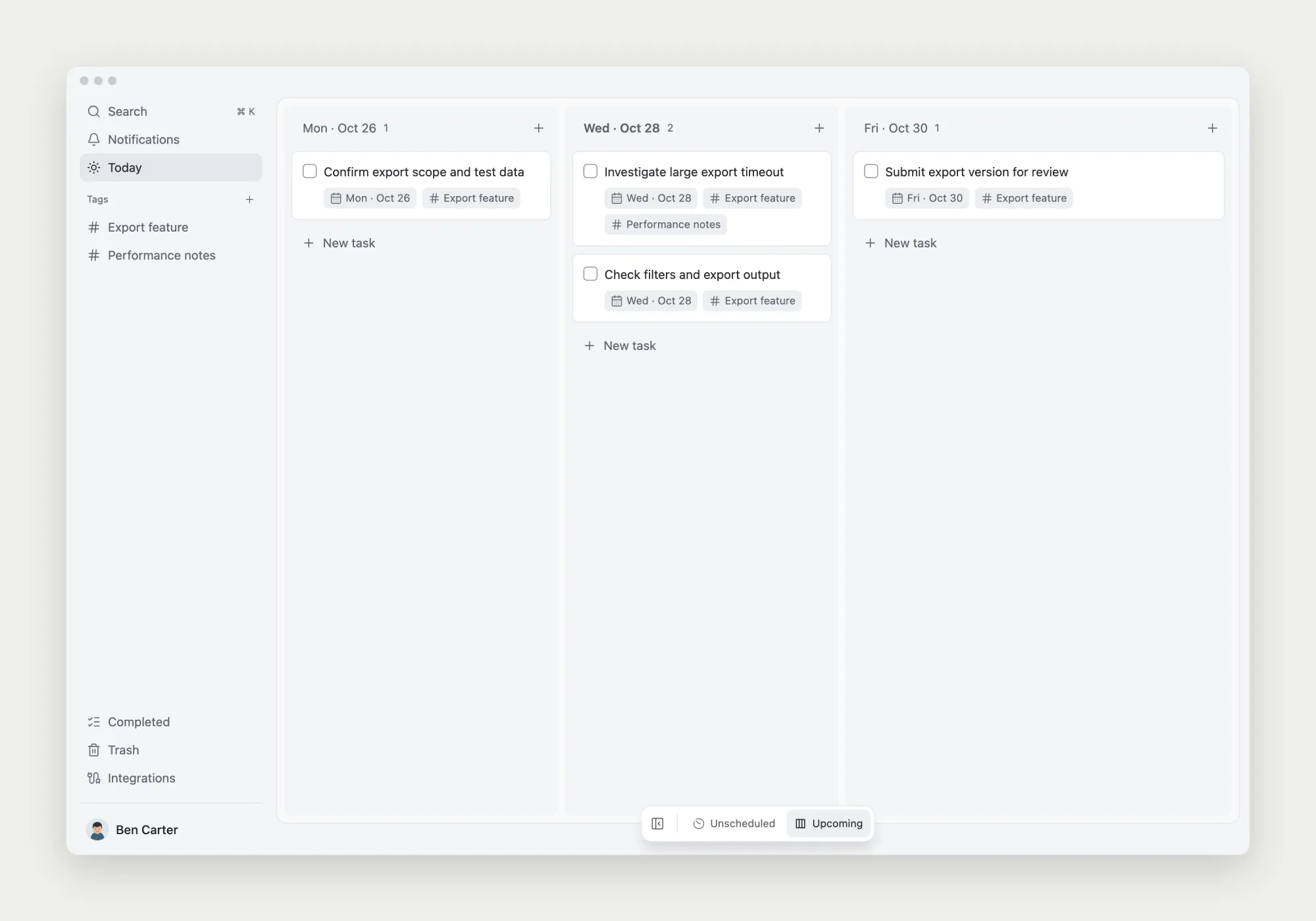
‘Build exports’ becomes a version ready for review on Friday: agreed filters implemented, output fields checked and test evidence available. Production release still follows the team’s usual process.
Plan test data, implementation, review and verification separately. Set a start date for the next action you can actually begin. If field definitions need confirmation, follow up on that input before treating development as underway.
| When | Work to move forward | Record to keep |
|---|---|---|
| Mon · Oct 26 | Confirm scope and prepare test data | Field agreement and verification links |
| Tue · Oct 27 | Implement agreed filters | Commits and review questions |
| Wed · Oct 28 | Reproduce and investigate the timeout | Observations, hypotheses and checked change |
| Thu · Oct 29 | Check filters and export output | Coverage and unchecked boundaries |
| Fri · Oct 30 | Submit review version and reflect | Delivery status and a follow-up question |
State what an interruption changes
On Wednesday, a large-data test times out. Ben records the affected case and changes the day’s plan: reproduce and isolate the delay first, defer an optional filter. Any change to Friday’s scope needs discussion with the person responsible.
A separate ‘Investigate large export timeout’ task can have its own result. Link the original ticket and commits, and leave the current finding and next step. Update team commitments through the team’s established channel.
Separate observations, hypotheses and checks
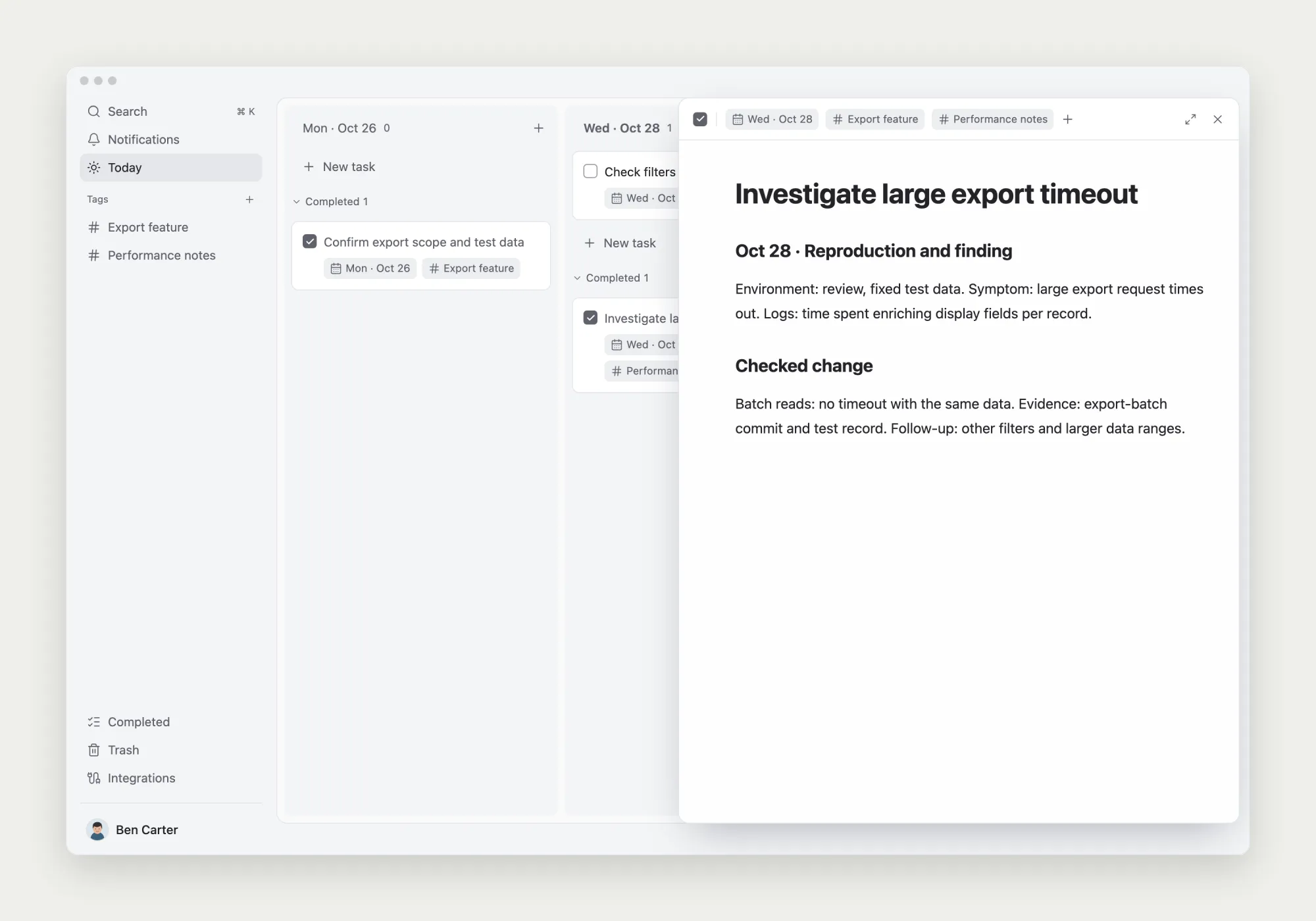
Record the environment, data range and reproduction steps before the hypothesis. In this example, logs locate the delay in per-record display-field lookups. After changing to a batch read, the same test data no longer produces a timeout. That supports a conclusion about this checked case.
Keep the commit and test record, plus the larger data range still unchecked. Google SRE’s postmortem practices connect factual findings to follow-up actions; a personal debugging note can begin with the same distinction.
Close investigation, verification and delivery separately
Located, fixed and verified in production describe different states. Ben closes the investigation with a bounded finding. Regression checks for filters and output remain a follow-up, and Friday’s review version still needs its evidence.
If a check fails, keep that task open and state what is missing. Link the finding back to the export ticket so the next reader can see why the code changed and what was actually checked.
Make one remaining question a focused exploration
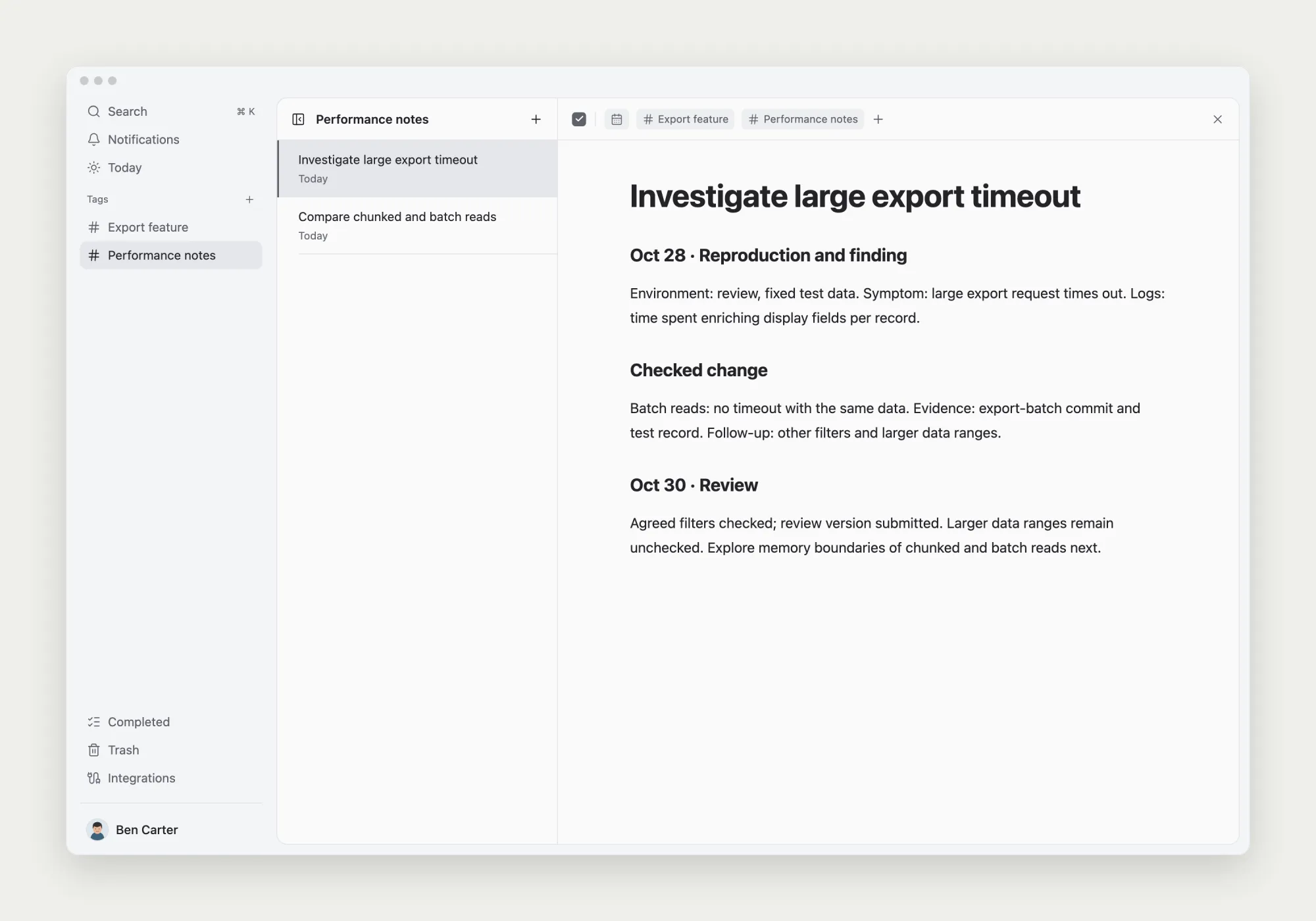
The fix leaves a question: when might a batch read still create memory pressure? Capture ‘Compare chunked and batch reads’, with the original investigation and the data boundary to examine. A broad database study does not need to become part of this week’s delivery.
On Friday, find the original task through ‘Performance notes’ and append the regression result. Continue the explanation and small experiment in the exploration task later. Keep the source note where it is; extract a shared document when the conclusion needs ongoing team maintenance.
Review delivery and understanding together
Check what reached review, what the interruption displaced and which question remains. A useful learning result might be an explanation you can give a colleague, a small experiment or a better check for the next change.
Continue with question-led knowledge notes when there is time to explore. Build a weekly report from the same facts when needed. Let one concrete deliverable leave evidence you can use again.