A product manager’s weekly plan can start with one decision that needs to move forward. Work backwards to the observations, discussions and inputs it requires. Keep research evidence, decision reasoning and untested assumptions distinct, then schedule a concrete validation task. The weekly result includes both a next step and a record of why it was chosen.
Maya is deciding what to investigate in first-project onboarding. Monday is for checking feedback, Tuesday for research, Thursday for a review and Friday for prototype preparation. TodoNote holds personal tasks and working notes, with links to the team’s research, designs and official decisions.
Plan around a decision with a bounded result
Narrow ‘improve onboarding’ to ‘choose the next help to test during first-project creation’. This week should produce a testable choice, the behaviour to observe and the questions still open. It does not need to promise a complete onboarding release.
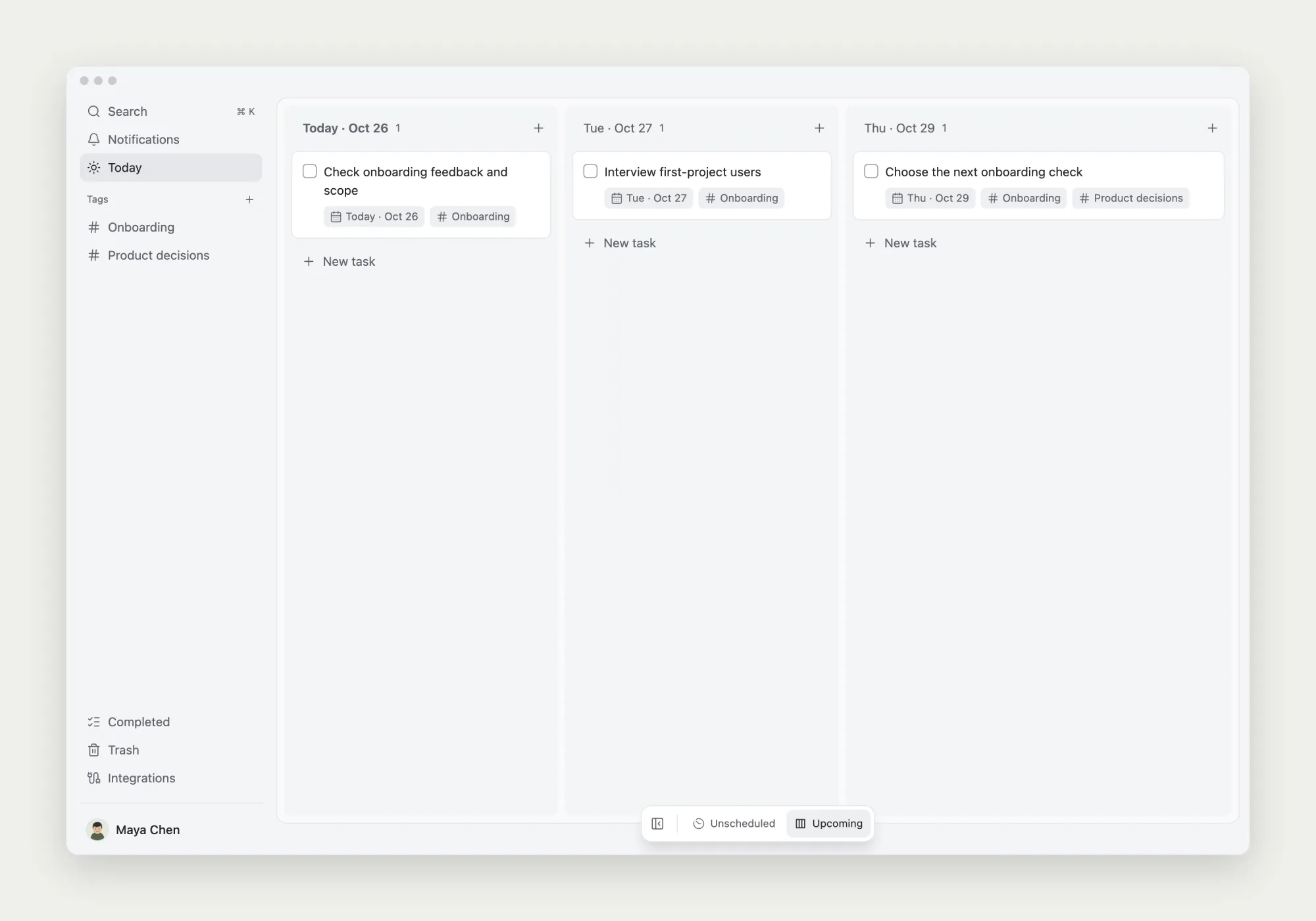
Check feedback Monday, observe creation Tuesday, interpret it Wednesday, review options Thursday and prepare Friday. If sessions are not booked, schedule that confirmation first; a review date cannot supply missing evidence.
| When | Work to move forward | Record to keep |
|---|---|---|
| Mon · Oct 26 | Check feedback and the decision scope | Sources and this week’s boundary |
| Tue · Oct 27 | Observe first-project creation | Behaviour and original notes |
| Wed · Oct 28 | Compare observations and explanations | Evidence, interpretations and contrasts |
| Thu · Oct 29 | Choose the next prototype check | Choice, reasoning and untested assumptions |
| Fri · Oct 30 | Prepare prototype and follow-up | Prototype status and an open research task |
Separate observations, interpretations and suggestions
U01 pauses when naming a project and asks what to do. U02 finishes creation but is unsure it succeeded. These are different observations, not evidence that every new user needs a tutorial. Unclear completion feedback is one explanation; an unclear task goal is another.
Keep what happened and its source in each research task. Summarise only what informs this decision and link back. GOV.UK’s research analysis guidance distinguishes observations, findings and actions, which is useful when preparing the discussion.
Leave the choice and the reason for deferring alternatives
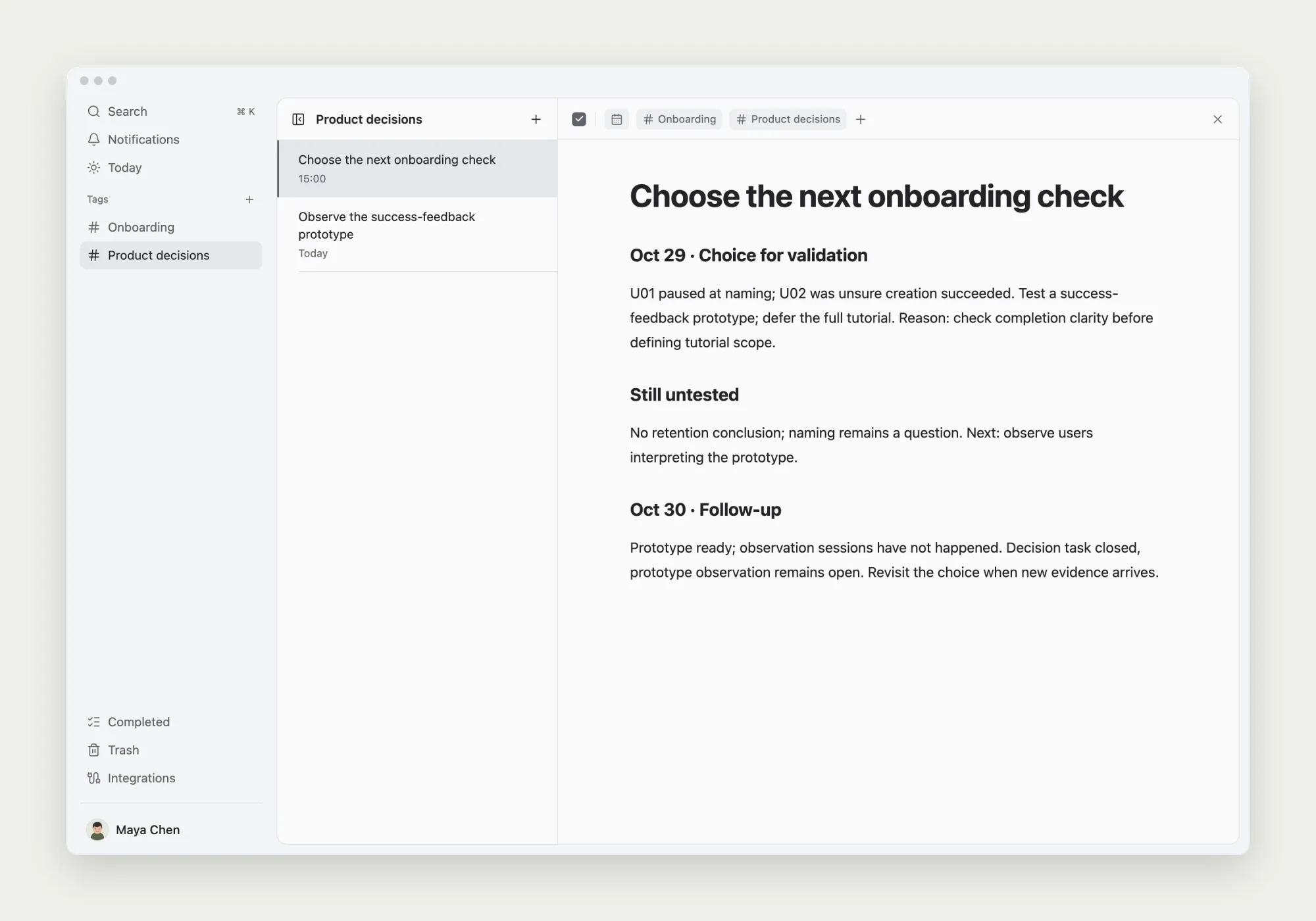
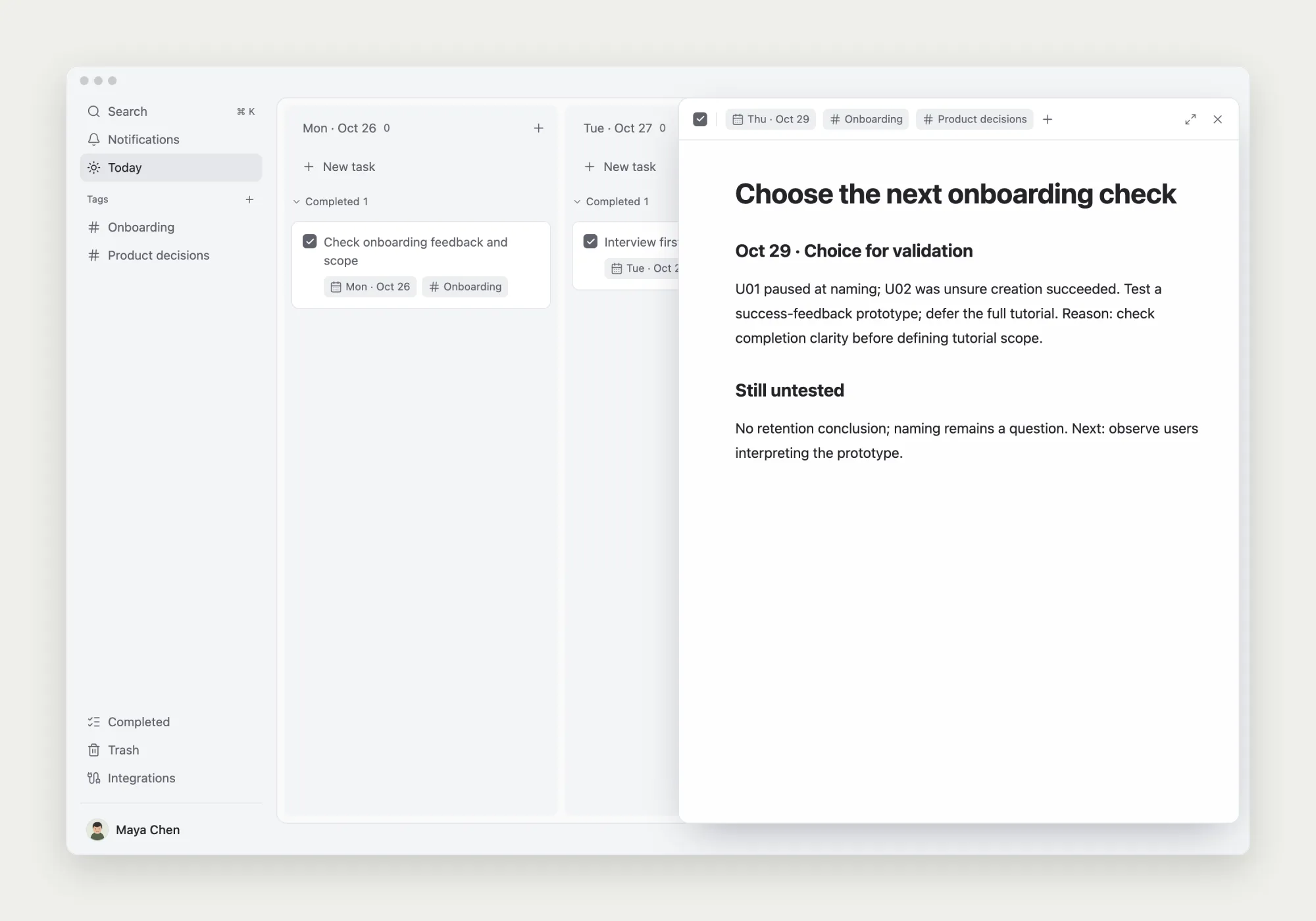
Thursday’s review compares a full tutorial with clearer creation feedback. The decision note records a smaller next test: prototype the success message and observe whether users recognise completion. Defer the tutorial because the observations do not yet define which steps it must cover.
State the boundary: this choice has not demonstrated improved retention or ruled out the naming problem. Keep the prototype reference, evidence and conditions for revisiting the decision. ‘Approved in review’ alone would lose that reasoning.
Make validation an action you can actually begin
‘Watch the effect’ becomes ‘Observe first-project creation with the success-feedback prototype’. Prepare the questions, participant arrangements and recording method. Completion requires observations and a follow-up judgement, not merely a finished prototype.
On Friday, the prototype is ready but sessions have not happened. Record those states separately. Use start dates for planned work and due dates for genuine commitments; when an input is missing, schedule a follow-up.
Return to the same reasoning at the next discussion
Tag the decision ‘Onboarding’ and ‘Product decisions’. Append Friday’s prototype status with a date. The decision task can close while the observation task stays open. The tag retrieves what was known, chosen and still uncertain.
When new evidence conflicts, add its date and the revised reasoning without erasing the old basis. Use a decision log for fuller records and return to research notes for the source. A useful week leaves a sharper question and an executable next step.