Useful literature notes let you recover a source, understand how its conclusion was reached, and distinguish the author's evidence from your interpretation. Record what serves your research question rather than paraphrasing every paragraph.
The conditions behind a result are easy to lose. “Method A is better” tells you little without the comparison, sample, and setting that produced it.
Explain why you are reading
Start with bibliographic details, a link or DOI, the reading date, and your question. Cornell Library's evaluation guidance begins with the citation and the source. Accurate references let you check versions and background later.
Keep methods, evidence locations, and limitations separate. When quoting, preserve the exact location and distinguish quotation from your paraphrase. Personal commentary should remain identifiable.
| Situation | Response | Record to keep |
|---|---|---|
| Author conclusion | Summarize with evidence location | Population and conditions |
| Direct quotation | Preserve wording and page | Separate from your prose |
| Your inference | State reason and unknowns | Do not label it an author claim |
| Follow-up | Read, verify, or test | Name the question to answer |
Keep conditions beside the number
PAPER-01 reads an internal signup research report. It records observed completions of 14/20 for A and 11/20 for B, alongside an unresolved question about group assignment. Those observations do not yet justify a general causal claim.
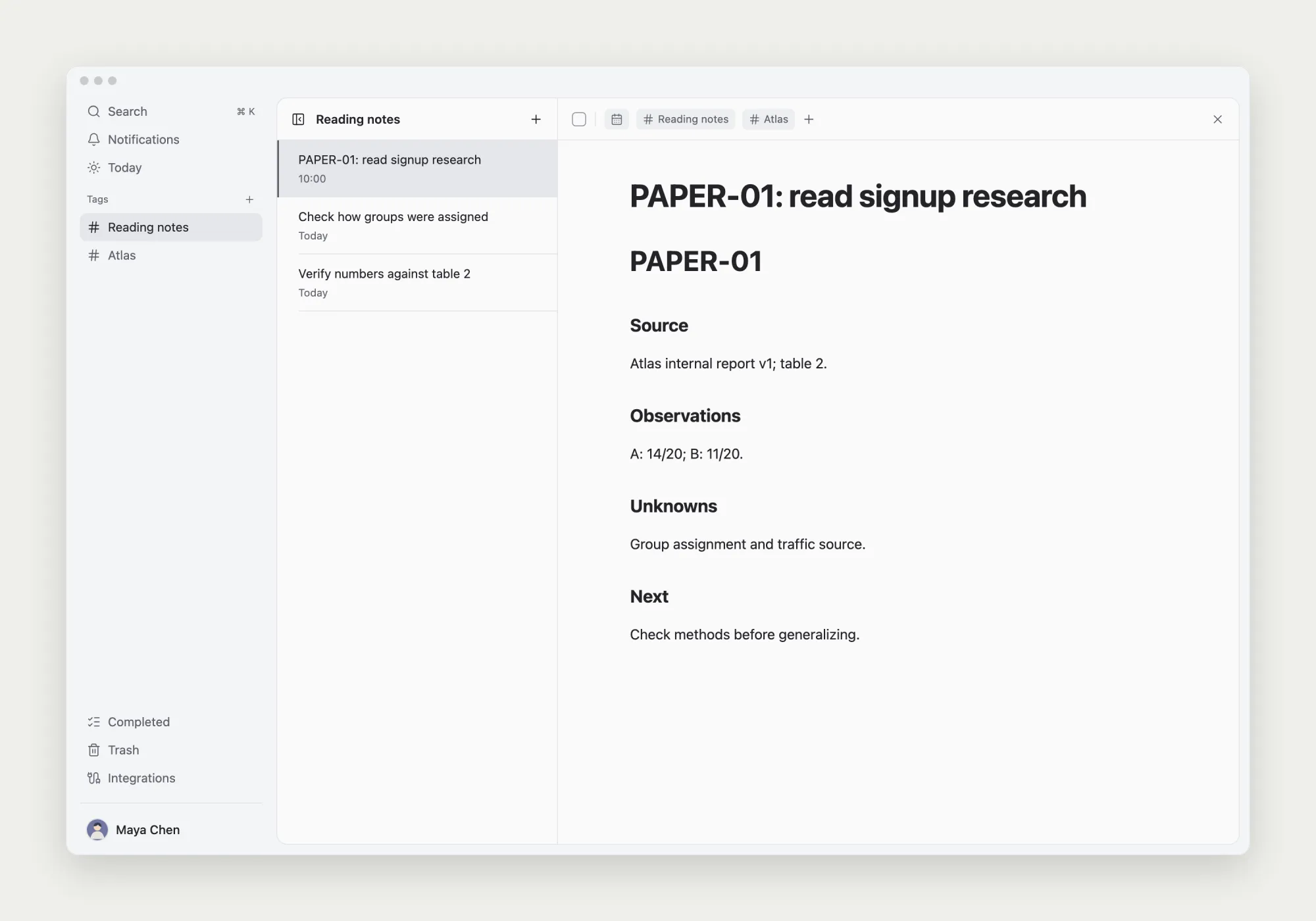
The example demonstrates a reading structure. For a published paper, add its real authors, publication details, and DOI when available. Do not invent missing attributes or confuse an internal report with a peer-reviewed paper.
Make your interpretation answerable
“May apply to mobile signup” is your inference. Follow it with the reason, the similarity of the samples and products, and the evidence still needed. A later reader can then see exactly where uncertainty begins.
In TodoNote, keep a reading task and its note together, with topic tags connecting related material. Make a method to investigate or a number to verify an explicit follow-up rather than burying it in prose.
Recheck before citing
Retrieve notes by research question and compare supporting, contradictory, and uncertain evidence. Results from different conditions should not be combined into one conclusion without examining those differences.
Before final citation, return to the original version, page, and table. Notes are a navigation aid; the source remains the evidence. An untraceable claim should stay a question to investigate.
A template to copy
Title and authors:
Publication and version:
Link or DOI:
Reading date and purpose:

Research question:
Population and method:
Evidence and locations:
Author conclusion and limits:
My interpretation and reasons:
Contradictory evidence or unknowns:
Next verification:Related workflow: Weekly planning for graduate research: connect papers, experiments and lab meetings
Sources and background: Cornell University Library