A useful weekly plan for a teacher starts with the timetable and existing commitments. Work backwards to preparation and marking, then record the classroom observations that should change the next lesson. Give those observations a follow-up task. At the end of the week, check both what you completed and what you will teach differently next time.
Emma teaches linear equations on Tuesday, checks targeted practice on Thursday and joins a department meeting on Friday. Her timetable remains the reference for teaching hours; TodoNote holds her preparation and follow-up work. One topic gives the week a thread without requiring a separate diary of every lesson.
Work backwards from the lessons already scheduled
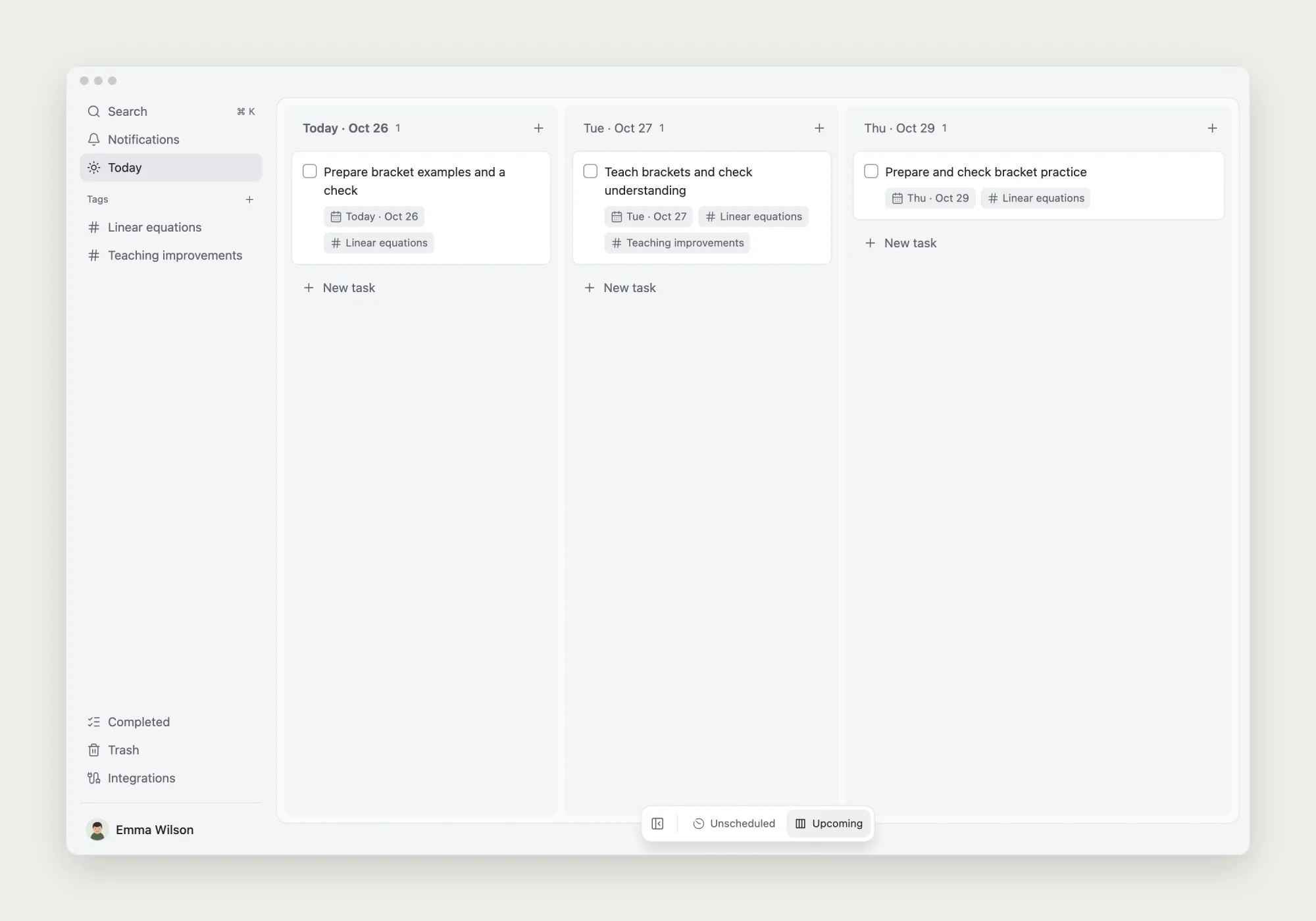
Replace a broad task such as ‘lesson prep’ with ‘Prepare bracket examples and a check question’. The result is concrete: worked steps, an example and a question that reveals a sign error. Monday’s preparation now has a clear stopping point.
Check teaching and meeting commitments before allocating preparation time. A start date records when you intend to work; use a due date when material genuinely must be ready before a lesson. There is no need to duplicate every timetable block as a task.
| When | Work to move forward | Record to keep |
|---|---|---|
| Mon · Oct 26 | Prepare examples and a check question | Worked steps and the point to check |
| Tue · Oct 27 | Teach and review check answers | Specific sign errors and explanations |
| Wed · Oct 28 | Prepare targeted practice | How it responds to Tuesday’s observation |
| Thu · Oct 29 | Run practice and check explanations | Changes and remaining uncertainty |
| Fri · Oct 30 | Prepare meeting notes and next steps | One thing to keep, adjust or revisit |
Leave room for marking and unexpected conversations
Keep a few outcomes visible: Tuesday’s lesson ready, Thursday’s practice informed by the lesson, and one observation for Friday’s meeting. Leave space for marking and conversations rather than filling every available gap.
When an extra request arrives, decide whether it needs attention today and which preparation it displaces. If time is short, finish the examples required for tomorrow and leave optional extensions unscheduled.
Record one observation that changes the next step
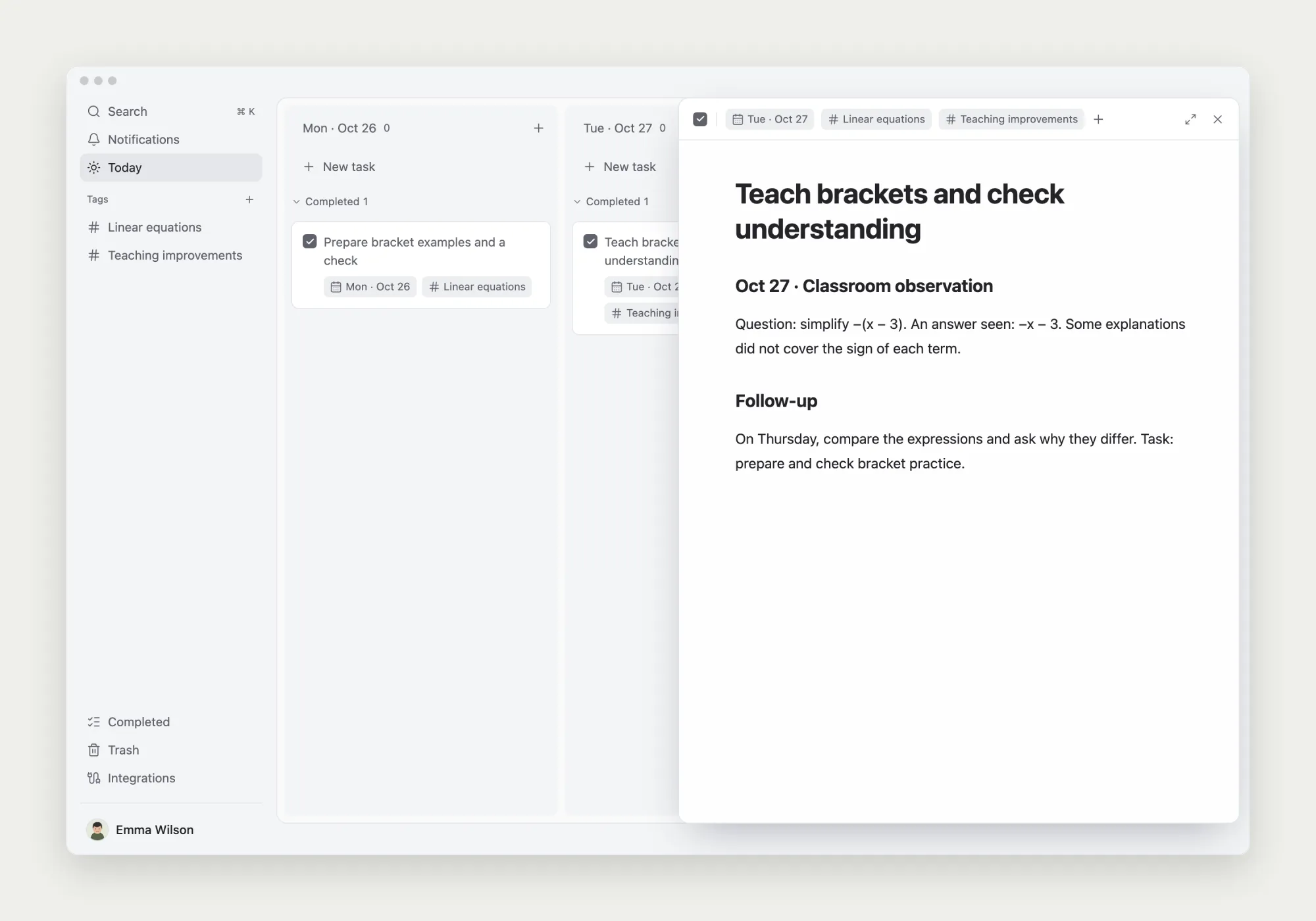
After Tuesday’s lesson, Emma notes that simplifying −(x − 3) produced answers of −x − 3. Follow-up explanations did not always account for the sign of each term. This identifies something to investigate rather than simply saying that pupils struggled.
She adds a response: compare the two expressions on Thursday and ask pupils to explain the difference. Keep the question, observation and next action. The EEF’s feedback guidance offers further context for using learning evidence to inform teaching.
Give the observation a follow-up you can finish
‘Watch for sign errors’ becomes ‘Prepare and check bracket practice’. The task points back to Tuesday’s question. Completion means running the practice and recording what the explanations reveal, including what remains unclear.
After Thursday, note which explanations changed and what needs another check. Completing Tuesday’s lesson task records that the lesson happened and its observations were saved; it does not establish that every pupil has mastered the topic.
Return to the original note when planning the topic again
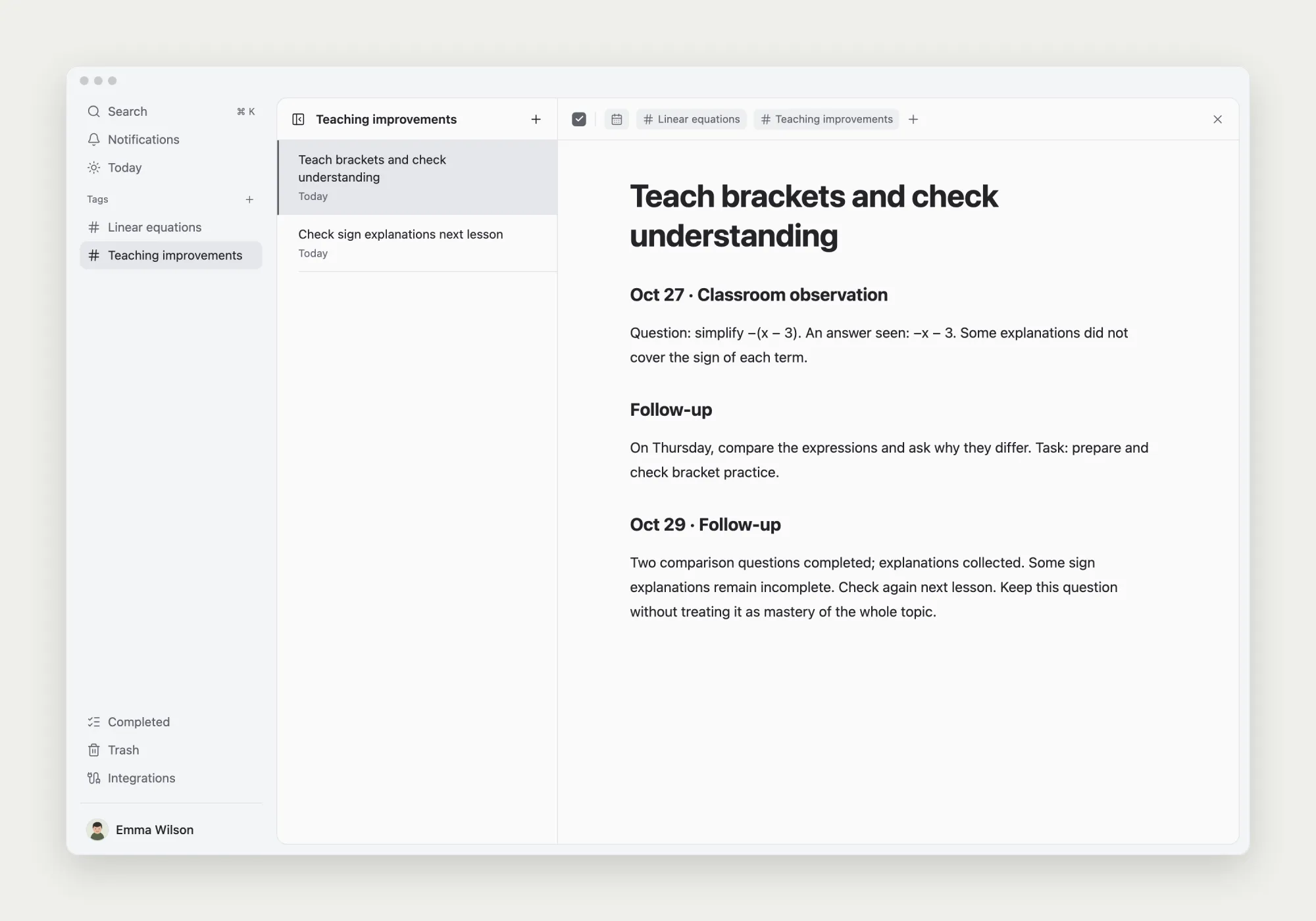
Add ‘Linear equations’ and ‘Teaching improvements’ to the lesson task. Append Thursday’s findings with a date. On Friday, open the teaching tag to find the completed lesson and its follow-up, alongside the question still worth checking.
Before teaching the topic again, review the original question, explanations and follow-up. Copy a useful check into the new preparation task while keeping last time’s results in their original context.
Review only what should change next week
Ask which preparation helped, which observation received a response and what needs another action. A question, some typical explanations and the revised practice give the department meeting something specific to discuss.
If recording becomes burdensome, keep fewer fields. Use a weekly review when you need a wider view, and recurring tasks once preparation steps become stable. Start by carrying one useful observation into the next lesson.