Research is sufficient when the evidence supports the decision you need to make. Define that decision, the conditions requiring proof and the findings that would change your choice. Set a review time, then decide whether to stop, narrow the remaining question or run another focused check.
“Research export libraries” has no natural endpoint. “Decide whether component A can deliver our current CSV export” gives the investigation a boundary.
Start with the decision
RESEARCH-01 covers an export feature with non-English column names. The current checks concern file size, content and license requirements. Spreadsheet styling might matter later, but does not determine this release.
The GOV.UK research planning guide starts with prioritized questions. Apply that starting point here: identify the uncertainty the current decision actually depends on.
Specify what would let you stop
Give each requirement a check. Inspect a generated file for column names, test a representative dataset for resource use, and review the official license under your team’s process.
| Unknown | Changes today’s decision? | Next action |
|---|---|---|
| Memory use at the required size | Yes; could block delivery | Run a focused test |
| Spreadsheet styling | No; this release needs CSV | Keep as a later question |
| Another similar component | No necessary capability identified | Do not automatically expand comparison |
What decision is another hour of reading likely to change? If you cannot name one, write down the current conclusion first.
A time limit is a review point
Reaching the time limit does not make an unanswered question safe to ignore. If memory use remains unknown, recommend holding integration and define the smallest test needed to decide.
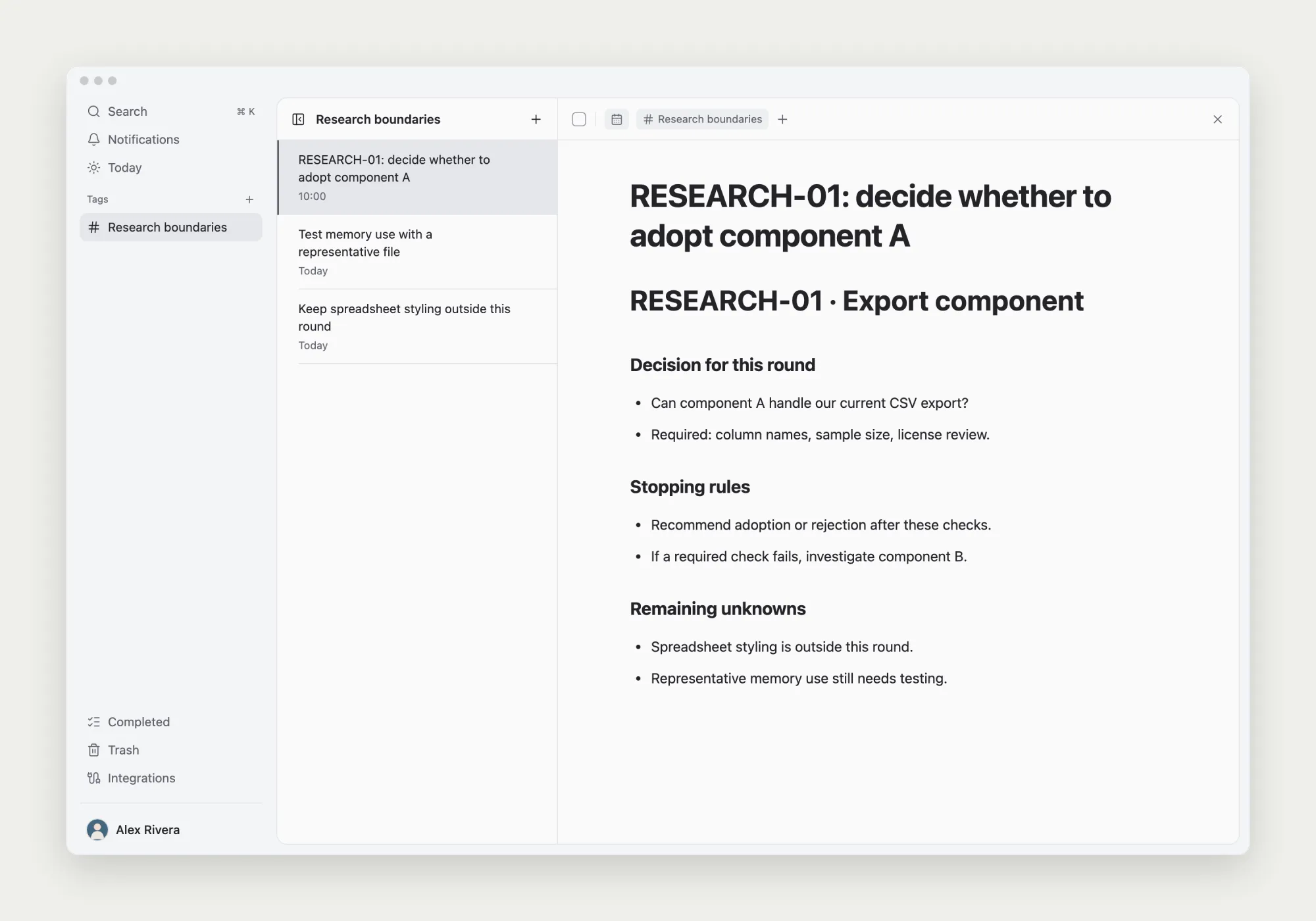
In TodoNote, keep the question, evidence locations and current conclusion in the research task. Create a separate task for the critical test so additional work has a clear reason.
Preserve the limits of the conclusion
A useful result might say: column names checked, license reviewed through the team’s process, large-file test outstanding, integration not yet recommended. That supports action more clearly than a page of unexplained links.
If another round is justified, record its trigger and required evidence. At the next review, check that gap rather than asking whether you have finished learning the whole subject.
Related practice: From research notes to a decision brief: write a recommendation