An incident postmortem records user impact, a timestamped timeline with a time zone, detection and recovery, supporting evidence and contributing conditions. Give each improvement an owner, a target date and a verification method, then append the review result so the work after recovery has a clear finish condition.
“Rolled back; add more tests” describes a response but leaves the next step vague. How did the configuration reach production? Why did the health check stay green? Which result would demonstrate that the missing safeguard now works?
Establish impact and reconstruct the timeline
In incident INC-11 on November 5, a configuration update at 09:02 causes new logins to fail; existing sessions remain usable. A user reports the problem at 09:08. Evan identifies the configuration difference at 09:12, rolls back at 09:20 and sees the login probe recover at 09:24. All times are UTC+8.
09:24 marks the successful recovery probe. The total number of affected users still needs log analysis. Leave that unknown visible and schedule the check. Identify each timeline source, such as deployment history, request logs or a report, and label estimated times.
Separate observations, explanations and open questions
| Type | Example | Treatment |
|---|---|---|
| Observation | New logins fail after the 09:02 update | Keep deployment and request-log references |
| Supported explanation | Production callback URL is missing; rollback restores the probe | Connect the configuration diff to failed requests |
| Open question | Affected-user count and missed alert | Assign checks and append findings |
The missing production callback URL is the direct cause supported by current evidence. A release check that omitted this field and a health check limited to process liveness are contributing conditions to investigate. Specific conditions help identify which safeguard to change.
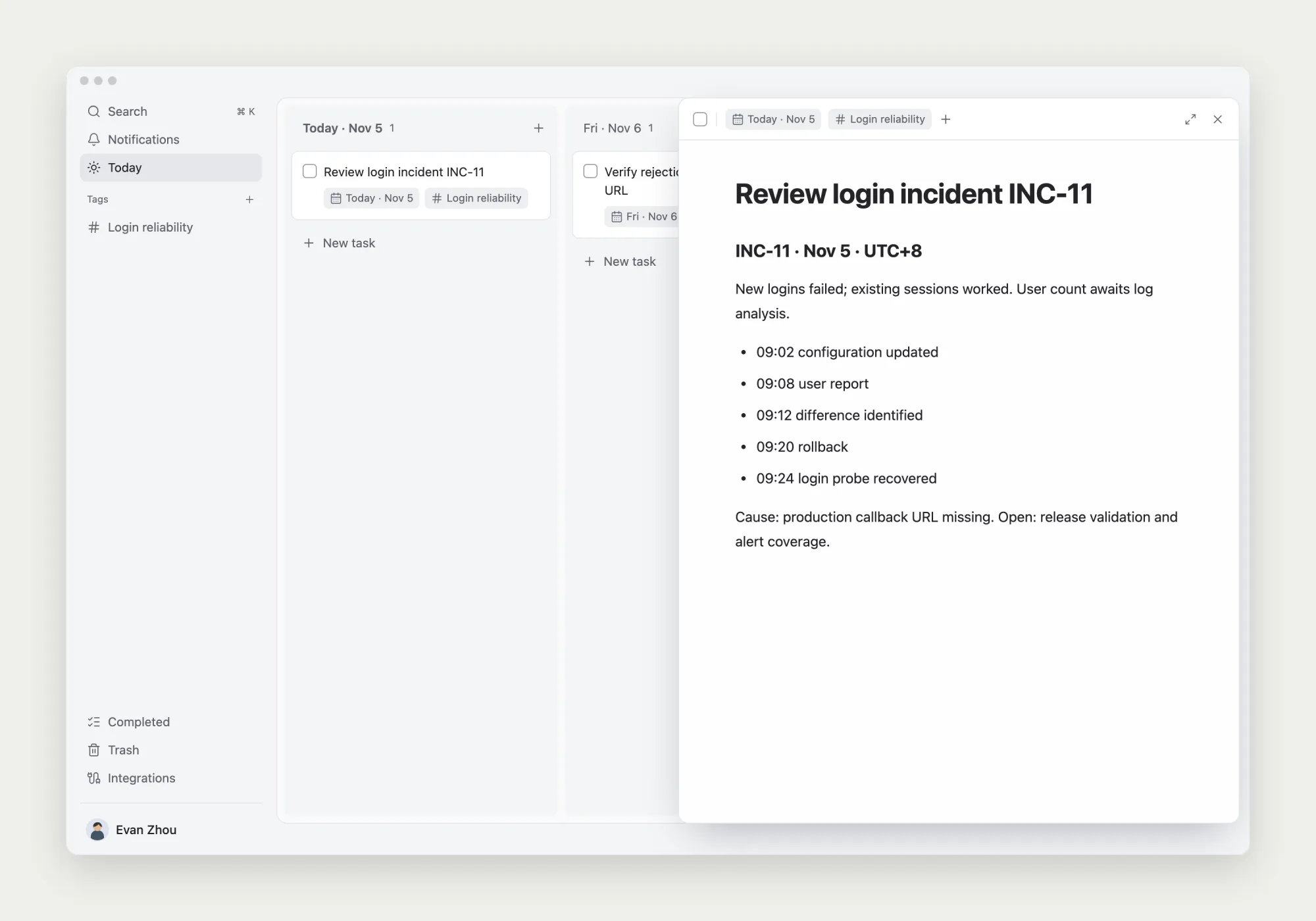
Capture what helped recovery as well as the gaps
A retained rollback version and an accessible configuration diff helped the response. Record those practices too. Process liveness did not establish that the login path worked. Describe decisions using information available at the time, rather than treating the later explanation as something responders already knew.
Google’s SRE postmortem guidance emphasizes a blameless account, concrete evidence and follow-through on actions. Here, configuration validation and login alerting become separate improvements with separate verification.
Copyable incident postmortem template
Incident ID / review status / author:
Affected function / users / missing impact data:
Start / detection / mitigation / recovery and time zone:
Timeline / source for each fact:

Response / information available / outcome:
Direct cause / supporting evidence:
Contributing conditions / detection and safeguard gaps:
What worked / unresolved questions:

Improvement / owner / priority:
Start date / target date:
Verification input / expected result / evidence location:
Review date / actual result / open items:
Dated additions / revised assessment and reason:Specify a test that can reveal a failed improvement
For configuration validation, provide a configuration missing the callback URL in a non-production environment: the release check must reject it, with saved output. For login monitoring, simulate a login failure and confirm that the alert reaches the agreed channel. Record the input, expected result, actual result and evidence.
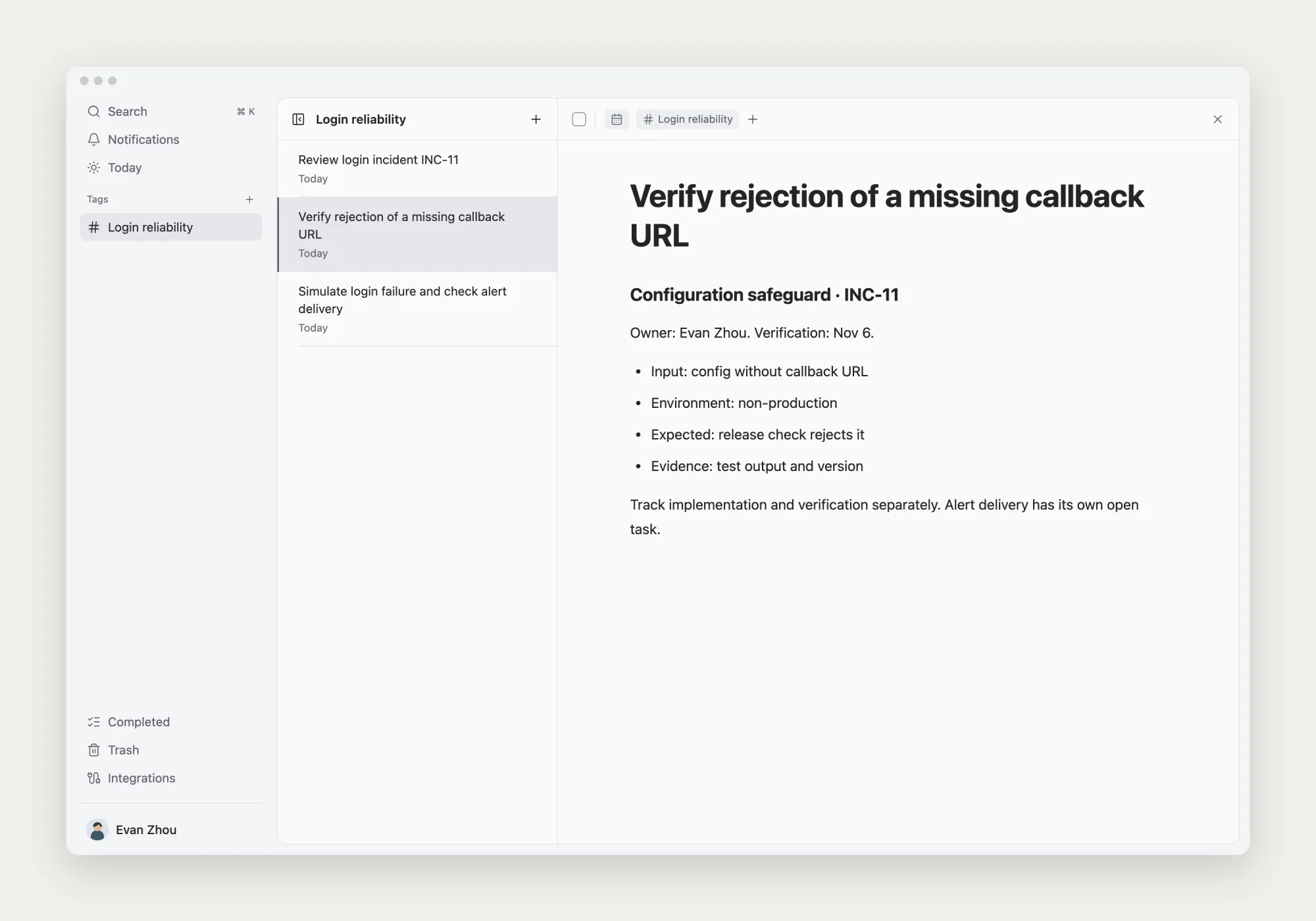
In TodoNote, keep the timeline and log references in the incident note. Create tasks or subtasks for the improvements, schedule start dates and real deadlines, and use the Login reliability tag to reconnect the event and checks. Team tickets, monitoring and the official review stay in their existing systems; notes retain links and outcomes.
Review implementation and verification separately
Merged validation code advances implementation. A passing check that rejects the invalid configuration satisfies the verification condition. If a probe is connected but alert delivery is untested, keep that work open. Append new evidence and dated revisions without replacing the original timeline.
Use the weekly review template to prioritize follow-up work. Use task breakdown when an improvement still needs smaller, verifiable deliverables.