An evergreen note develops an idea you expect to revisit. To derive one from work, write a clear claim, retain the supporting observation, state where it applies, and revise it when later evidence changes your understanding.
“Workshop notes, November” identifies an origin. “Offline readiness needs a device check” identifies a reusable judgment. Keep both records, but let them serve different retrieval needs.
Find the claim inside the event
Andy Matuschak describes evergreen notes as concept-oriented, allowing retrieval through an idea rather than only its source project. Look for a judgment that could help with another situation.
EVERGREEN-01 begins with a workshop delay: an attendee list existed but could not open offline on the check-in device. Preparing a file and verifying access on the actual device are separate checks.
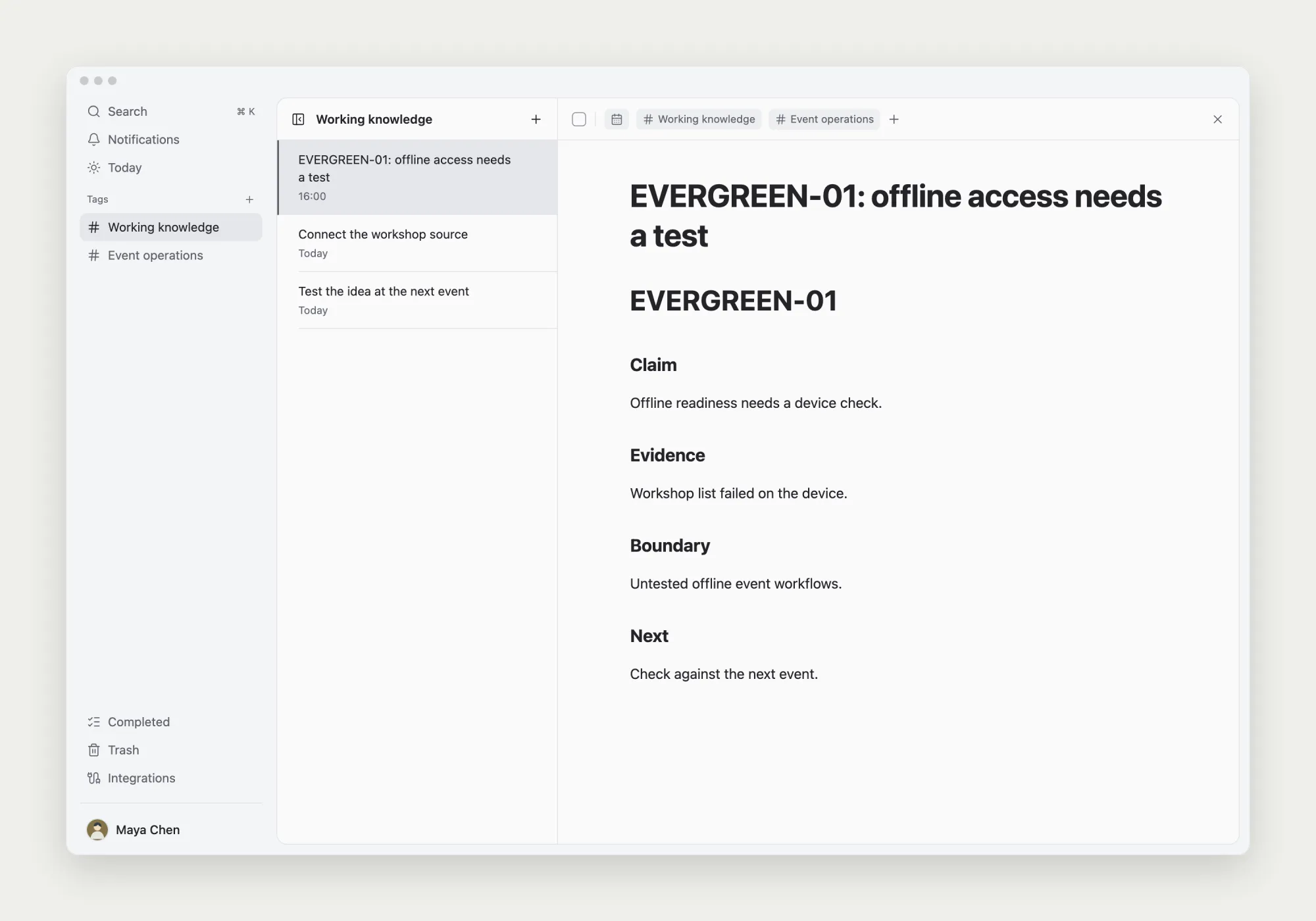
Keep the evidence and the boundary
| Part | Event record | Evergreen note |
|---|---|---|
| Title | November workshop check-in | Offline readiness needs a device check |
| Evidence | List failed on the device | File existence does not establish access |
| Boundary | This event and device | Untested offline access |
| Future use | Recover the timeline | Decide whether to test the device |
Preserve the event in its original task. Explain how it supports the new claim and refer back using an available link or a clear source ID and title. The evergreen note need not copy the complete timeline.
One workshop does not prove that every file workflow needs another approval. State the useful condition: an event depends on offline access on a device not yet tested. That boundary makes the judgment easier to apply sensibly.
Leave room for evidence that changes the idea
Add counterexamples when you encounter them. If a later event uses an already tested distribution process, explain when an additional check adds little value. Evergreen means continued development, not that the initial wording is permanently true.
In TodoNote, retain the completed workshop record and create a separate note under a topic tag. Use a claim-based title. During the next event plan, retrieve the topic and turn the idea into an action only if its condition applies.
Evergreen note starter
Claim-based title:
Main idea:
Why it matters:
Source task / date:
Observed evidence:
Reasoning from evidence to claim:
Conditions where it applies:
Limits / counterexample:
Related concept:
Next situation to test:
New evidence:
Last substantive revision:Write one idea worth returning to
If the note only makes sense beside the original timeline, add the missing reasoning. If it promises more than the evidence supports, narrow the claim. A useful note can be short and still be revisable.
Read next: PARA vs Zettelkasten: choose for delivery, long-term thinking or both
Sources and background: Andy Matuschak