To organize conference notes, first capture the session, speaker, source locations and useful timestamps. Separate the speaker’s claims from your interpretation and open questions. Keep the original rough notes, add topic tags that support later retrieval, and turn selected source checks, experiments or conversations into bounded follow-up tasks.
Web Summit 2026 runs November 9–12. Whether you attend in person or watch talks online, a dense program can leave you with scattered links and screenshots. Prepare a lightweight note before the event, then organize material around your own questions rather than transcribing every talk.
Keep enough context to return to the source
Use a separate record for each talk. Include the event, date, session, speaker and topic. Add a slide number or recording timestamp for important ideas. If materials have not been released, mark them as pending and add the actual URL later rather than guessing a recording address.
Ryan is organizing a cache-practice session from a local technical meetup on November 2. His rough notes contain “hit rate,” “old value after refresh” and “test conditions.” He keeps that original record and adds source positions and questions. An unclear fragment should not become a confident statement during cleanup.
Distinguish what was said, what you inferred and what to test
Give the note three layers: the speaker’s point, your interpretation in your work context, and material that needs checking or testing. Use a direct quotation only when its wording has been retained and checked. Label summaries as paraphrases so personal inferences do not read like the speaker’s promises.
| Kind | Example | Follow-up |
|---|---|---|
| Speaker’s point | Observe reads after updates as well as hit rate | Check slide 18 |
| My interpretation | Our project should inspect post-update reads too | Confirm the relevant scenario in project docs |
| Question to test | When does a controlled test read the new value? | Design a small experiment with recorded conditions |
These entries lead to different work. Hearing a suggestion does not establish that it applies to your system. Wanting to try it does not demonstrate effectiveness. Keeping those distinctions makes a later team discussion clearer about what came from the talk and what remains your own question.
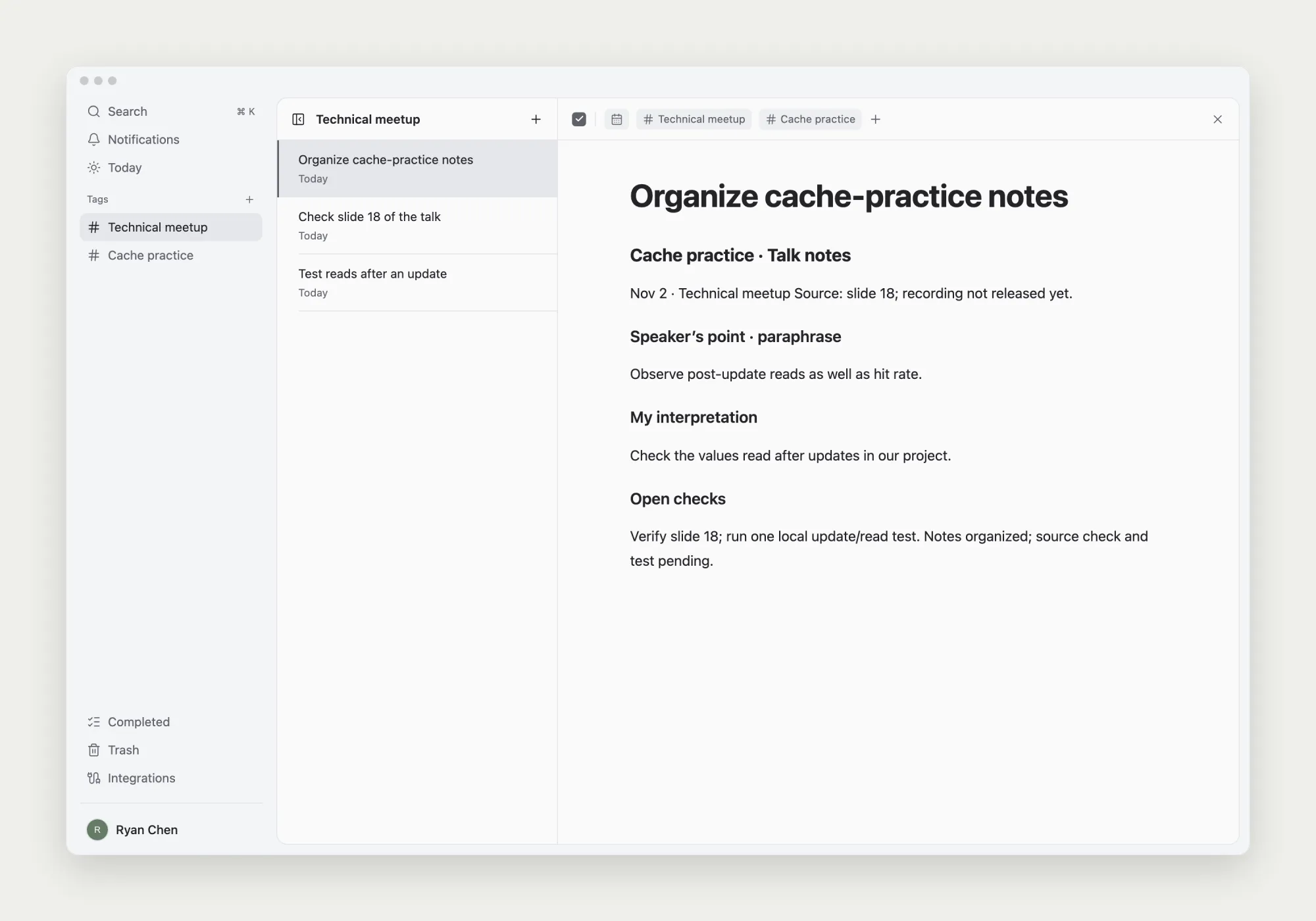
Use event tags for context and topic tags for retrieval
In TodoNote, Ryan adds “Technical meetup” and “Cache practice” to the talk record. The event tag groups material from that gathering. The topic tag helps him find the talk again alongside debugging notes and experiments when a cache question returns.
Do not create a tag for every word you heard. Add a stable topic when you expect to retrieve related records again. Source links and timestamps stay in the original note; tags organize access rather than replace attribution. See organizing note tags around retrieval needs for more detail.
A copyable conference notes template
During the talk, fill only what is quick to capture. Add interpretation and actions afterward. Allow unknown resource status instead of filling a gap with an assumption.
Event / date / session:
Speaker / topic:
Resource location / slide or timestamp:
Resource status: available / pending / not found

Speaker’s point: paraphrase or checked quotation:
Original rough notes / unclear fragments:
My interpretation / related work question:
Fact to verify / required source:

One thing to try / reason:
Inputs / comparison method / completion criteria:
Follow-up task / planned date:
Actual result / limitations / record location:
People to share with / unresolved points to disclose:Choose one question worth a bounded experiment
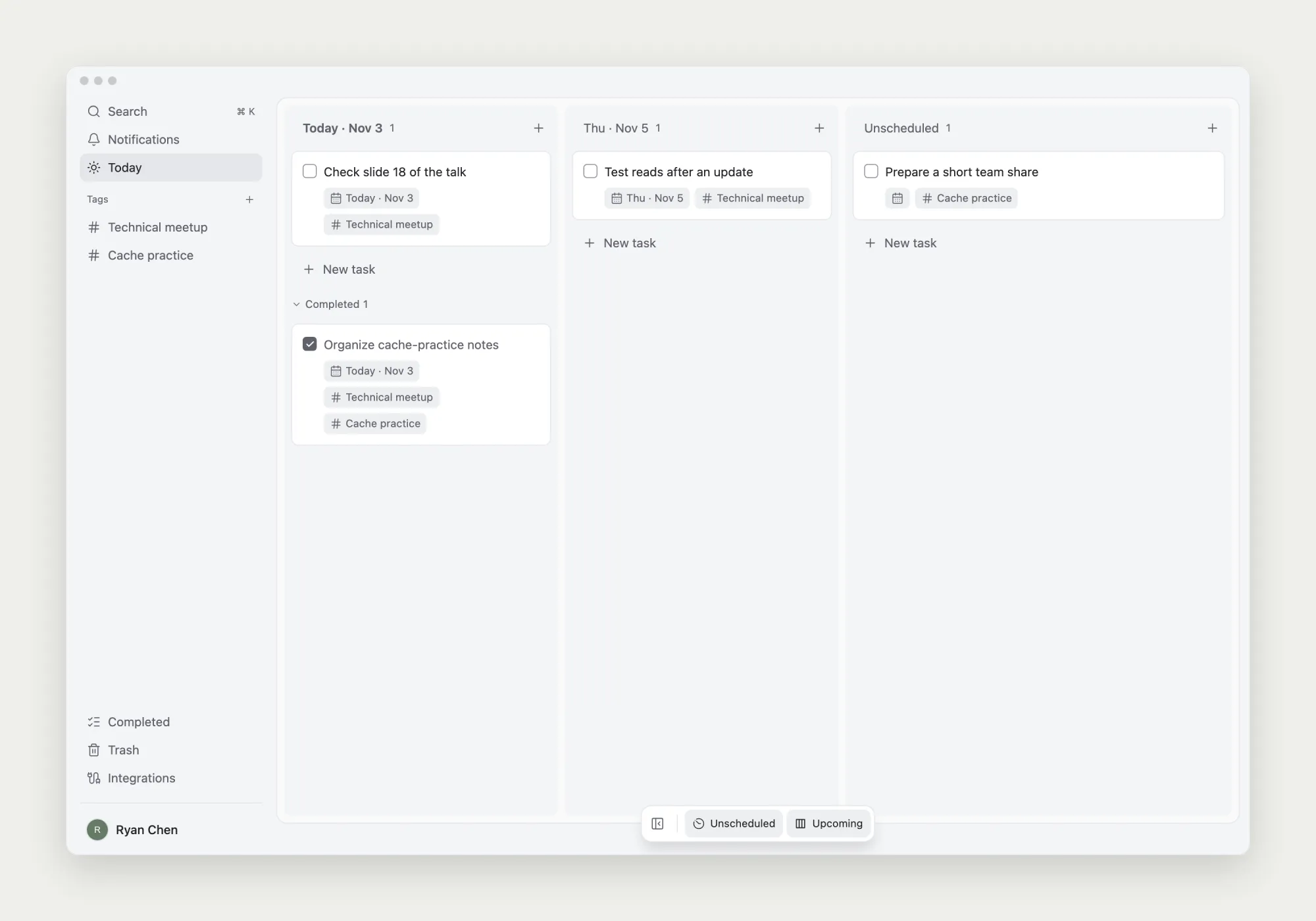
Ryan plans to check slide 18 first, then inspect post-update reads with local test data. The experiment record will include environment, initial value, update operation, read order and observed output. Keeping conditions explicit helps answer a project-specific question before considering a broader architectural conclusion.
The note cleanup can be finished while the source check and experiment remain open. Schedule the next actions without assigning deadlines to every interesting idea. Keep ideas without a current purpose unscheduled and put only the experiments you intend to run into the active plan.
Update the record with results before sharing or expanding
After the experiment, add observed output, conditions and unresolved questions to its task note. The topic tag still leads back to the original talk. If your interpretation changes, date the correction and explain it while retaining the rough-note location, so the earlier interpretation does not return as an established fact.
A useful team share can contain one relevant idea, its connection to current work, the checks you have completed and what remains untested. To explore further, use the approach in turning an exploration into a useful knowledge note. You do not need an essay for every talk: a retrievable source and one worthwhile next action can be enough.